FLYLYFE JOURNAL · LAS MALVINAS SON ARGENTINAS
What Does “Las Malvinas Son Argentinas” Mean?
“Las Malvinas son argentinas” means “the Malvinas are Argentine.” Malvinas is the Spanish name for the Falkland Islands, which the United Kingdom administers today.
FLYLYFE · PUBLISHED 2026-07-30 · UPDATED 2026-10-30
The short answer
The word. Malvinas is the Spanish name of the South Atlantic islands called the Falkland Islands in English. The Spanish name comes from the French Îles Malouines, after the port of Saint-Malo. One archipelago, two names.
The sentence. “Las Malvinas son argentinas” translates as “the Malvinas are Argentine,” or “the Falklands are Argentine.” In Argentina it is a national claim of belonging, taught in school and painted in public, and it has been in the constitution since 1994.
Argentine or British. The United Kingdom administers the islands today. Argentina says they are Argentine. The United Nations has not given them to either side: in 1965 it invited both governments to negotiate, and the dispute is still open. The sourced detail is below.
What the word Malvinas means
Malvinas is not a slogan. It is a place name. In Spanish the islands are the Islas Malvinas. In English they are the Falkland Islands. United Nations documents use both, with the order flipped by language: Falkland Islands (Malvinas) in English, Islas Malvinas (Falkland Islands) in Spanish.
The Spanish name comes from French. In 1764 Louis-Antoine de Bougainville named the islands Îles Malouines after Saint-Malo, the Breton port his expedition sailed from. Britannica, Etymonline, and Argentina’s national geographic institute all trace Malvinas to Malouines.
The English name has a separate root. Falkland Islands comes from Falkland Sound, the strait Captain John Strong named in 1690 for Viscount Falkland. The name was later extended to the whole archipelago.
Malvina, the woman’s name, is unrelated. It does not mean “little Malvinas,” and it is not what Spanish speakers mean when they say the islands.
English translation of the phrase
Word for word, “Las Malvinas son argentinas” means “The Malvinas are Argentine.” If the Spanish name is unfamiliar, “The Falklands are Argentine” names the same islands. Both are translations, not a ruling on sovereignty.
“Las Malvinas son argentinas o inglesas” means “Are the Malvinas Argentine or English?” In everyday Argentine Spanish, inglesas here means British. The precise status is narrower than “part of England.” The United Kingdom administers the islands as a British Overseas Territory, with their own local government. England is one country inside the United Kingdom. It is not the legal name of the territory.
Searches for “las malvinas son argentinas meaning,” “translation,” and “in English” are all asking for this pair of sentences: what the words say, and who actually administers the islands. Those are different questions. The next sections keep them apart.
What the phrase means to Argentines
Inside Argentina the line is not read as one party’s slogan. It is read as a shared statement that the islands are national territory, whichever government is in office. It shows up on road signs, murals, school acts, and in football grounds. The long form, the one painted in full, is “las Malvinas fueron, son y serán argentinas” — they were, are, and will be Argentine.
Since the 1994 constitutional reform, that claim has constitutional rank. The first temporary clause says the Argentine Nation “ratifica su legítima e imprescriptible soberanía” — ratifies what it calls its legitimate and imprescriptible sovereignty — over the Malvinas, South Georgia, and the South Sandwich Islands and the corresponding maritime spaces, as an integral part of the national territory. The same clause says recovering them, while respecting the islanders’ way of life and international law, is a permanent and unrenounceable objective of the Argentine people. The official text is on the Congress of the Nation site.
That is the cultural meaning. It does not, by itself, decide who administers the islands today. Both facts stand at once: a near-consensus inside Argentina, and a dispute the United Kingdom does not accept. FLYLYFE is a New York house-music label, started in 2007, out of nightlife rather than a campaign. This page explains the line because people meet it on a shirt, in a stadium, and in a search box.
Football and fan culture
Argentina versus England has carried the war ever since 1982. On 22 June 1986, at the Azteca, Argentina knocked England out of the World Cup quarterfinals, 2–1. Diego Maradona scored first with his hand — the Hand of God — and minutes later the goal remembered as the Goal of the Century. He later talked about the match as symbolic payback for 1982. Britannica’s life of Maradona covers that match.
At Qatar 2022 the terraces set it to music. A fan, Fernando Romero, adapted a La Mosca song, and the chant put the soldiers who died in the Malvinas in the same celebration as Diego while Argentina beat France in the final. That win is the third star: 1978, 1986, and 2022. There is no fourth.
On 15 July 2026 the sentence was back on the pitch. In the semifinal in Atlanta, Argentina beat England 2–1, and players including Giovani Lo Celso and Lisandro Martínez raised a banner with the phrase. FIFA opened a disciplinary case for using a sporting event for demonstrations of a non-sporting nature. On 19 July, Spain won the final 1–0 at MetLife Stadium. Argentina’s stars are still three. The World Cup conspiracy note covers the final itself; this page is about the words on the banner.
Argentine or British: the dispute on the record
“Are they Argentine or English?” sounds like a yes-or-no question. It is three questions. Mixing them is how a fact turns into a chant.
Who administers them today
The United Kingdom. The islands are a British Overseas Territory named the Falkland Islands, not a part of England. On 10–11 March 2013 islanders voted on whether to keep that status: 1,513 votes (99.8%) in favor and 3 against. The BBC and the UK government both published that result. Argentina does not accept the referendum as the end of its claim.
What each country argues
Argentina says it inherited the islands from Spain and that on 3 January 1833 a British force took the settlement. It has protested ever since, and the 1994 constitution writes the claim down. The United Kingdom says it has administered the islands continuously since 1833, except for the Argentine occupation from April to June 1982. The BBC sets the two positions side by side without merging them.
What the United Nations says
It does not award sovereignty to either government. Resolution 2065 (XX), adopted on 16 December 1965, invited both governments to negotiate a peaceful solution, bearing in mind the interests of the population. The Special Committee on Decolonization (C-24) has had the question on its agenda since 1964 and still adopts a yearly resolution on the islands. The current text lives on that UN page.
The 1982 war is the memory inside the phrase. These are the casualty figures the BBC publishes. On 2 April 1982 the military dictatorship then ruling Argentina landed troops. The United Kingdom sent a naval task force. Argentina surrendered on 14 June. The BBC puts the dead at about 650 Argentine servicemen, 255 British servicemen, and 3 island civilians. Britannica covers the 74-day war. The defeat hastened the end of that dictatorship. In Argentina, “los pibes de Malvinas” names that generation.
Why the line is on a New York tee
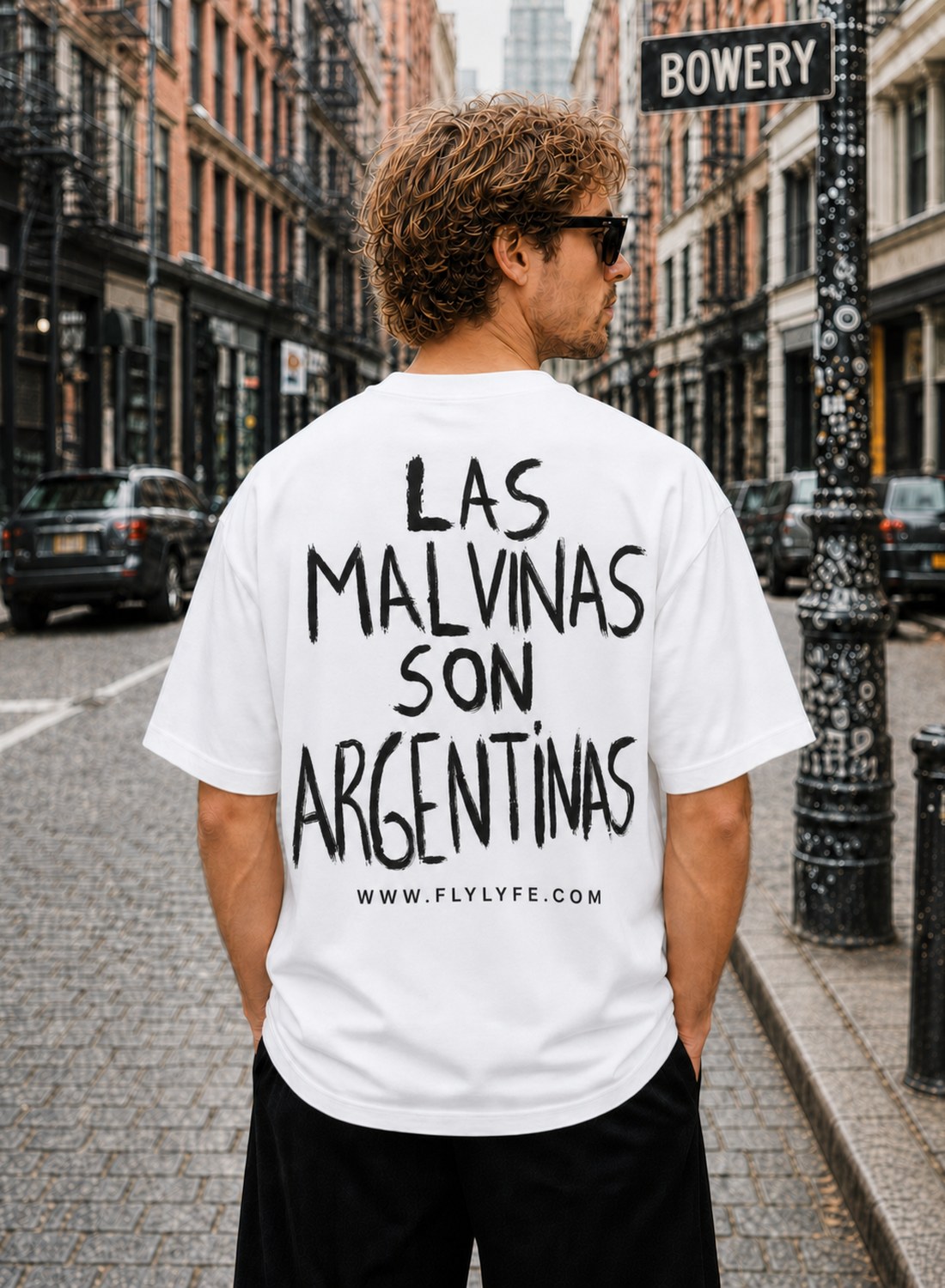
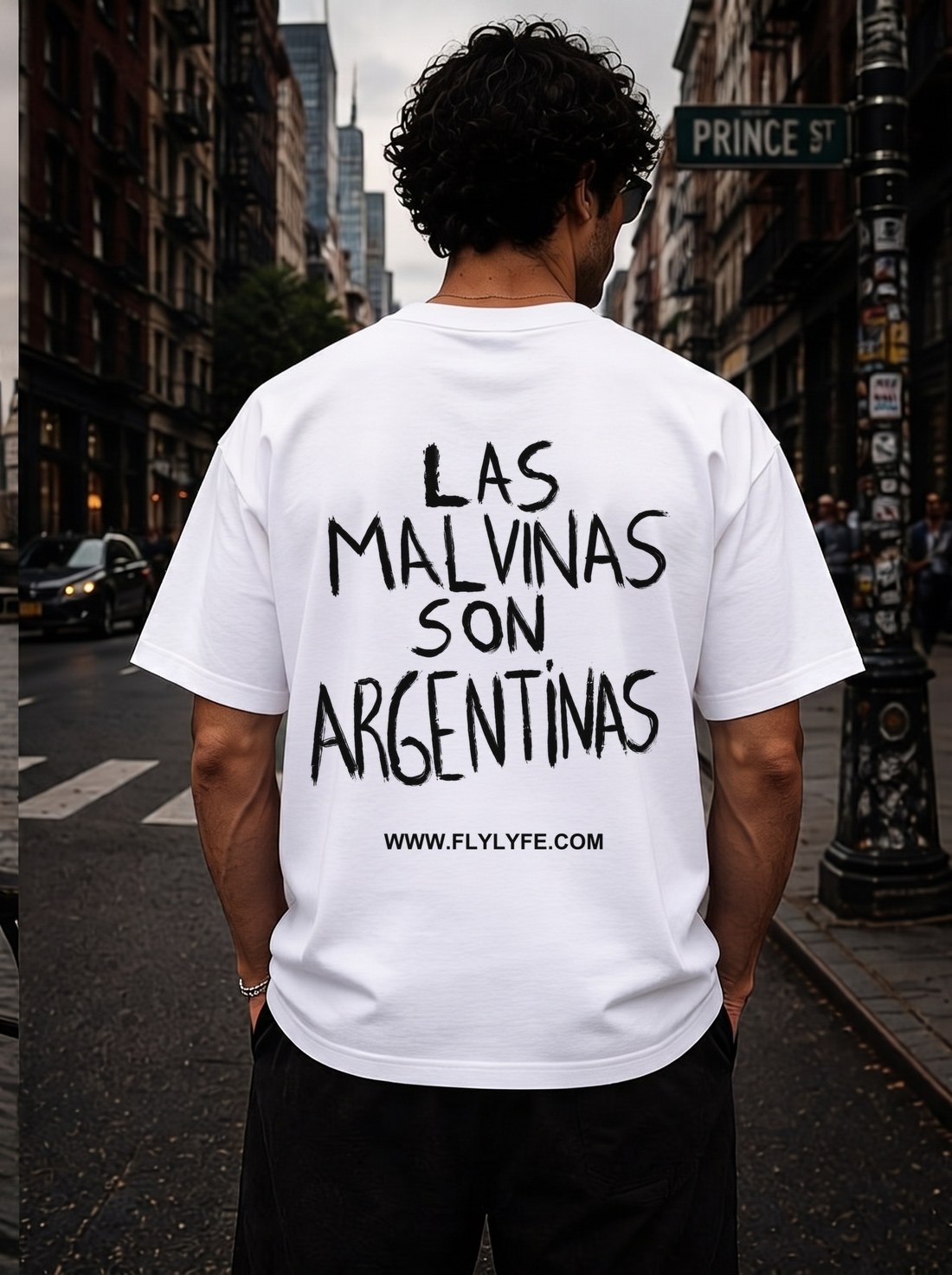
A sentence this heavy does not stay in a textbook. People wear it. FLYLYFE prints it in the Heritage line the way it already travels among fans and the diaspora: memory and identity, on cotton, not as a communiqué. The label started in New York nightlife in 2007. The tee is not an official national-team jersey.
The Spanish shop pages are the hand-painted Las Malvinas tee, with the phrase across the back and a quiet front, and the Argentina three-star tee, with 1978, 1986, and 2022, a gold outline of the islands, and the semifinal date 15 July 2026. Each is USD $39.99, made to order, and ships to Argentina from USD $19.49 for one tee, calculated by weight at checkout.
The same two designs in English are the Las Malvinas Tee and the Las Malvinas Campeones Tee. Women’s cuts: Las Malvinas relaxed, Las Malvinas fitted, Campeones relaxed, and Campeones fitted. The full Spanish cluster is on FLYLYFE remeras argentinas. The Spanish explainer is qué significa Las Malvinas son argentinas.
Sources
Place name: Britannica, Etymonline, and Argentina’s Instituto Geográfico Nacional. Constitution: Congress of the Nation. Dispute and referendum: BBC and the UK government. United Nations: resolution 2065 (XX) and the C-24. The 1982 war: Britannica. The 2026 FIFA case: Al Jazeera.
Frequently asked questions
What does “Las Malvinas son argentinas” mean in English?
It means “the Malvinas are Argentine.” Malvinas is the Spanish name for the Falkland Islands, so the line is also translated “the Falklands are Argentine.” In Argentina it is a claim that the islands are part of the national territory.
What does the word Malvinas mean?
Malvinas is the Spanish name for the Falkland Islands. It comes from the French Îles Malouines, the name Louis-Antoine de Bougainville gave the islands in 1764 after the port of Saint-Malo. The English name comes from Falkland Sound, named in 1690. They are two names for one archipelago. The woman’s name Malvina is a different word.
How do you translate “Las Malvinas son argentinas o inglesas”?
It translates as “Are the Malvinas Argentine or English?” In everyday Spanish, inglesas in this question means British. The islands are not part of England. The United Kingdom administers them as a British Overseas Territory. Argentina says they are Argentine. The dispute is unresolved.
Are the Malvinas Argentine or British?
The United Kingdom administers them today as the Falkland Islands, a British Overseas Territory. In a March 2013 referendum, 1,513 votes (99.8%) were in favor of staying a British territory and 3 were against. Argentina does not accept that vote as the end of the sovereignty dispute and keeps the claim written into its 1994 constitution. The United Nations still treats the question as a dispute to be negotiated.
What does the phrase mean to Argentines, including in football?
In Argentina it is a shared statement of belonging, taught in schools and painted in public, not the property of one political party. It is tied to the memory of the 1982 war and to the football rivalry with England: Diego Maradona in 1986, a 2022 terrace song, and the banner players raised after Argentina beat England in the 15 July 2026 World Cup semifinal.
What does the United Nations say about the Falkland Islands?
It does not award the islands to one side. General Assembly resolution 2065 (XX), adopted on 16 December 1965, invited Argentina and the United Kingdom to negotiate a peaceful solution, bearing in mind the interests of the islands’ population. The Special Committee on Decolonization (C-24) has considered the question since 1964 and still adopts a yearly resolution on it.